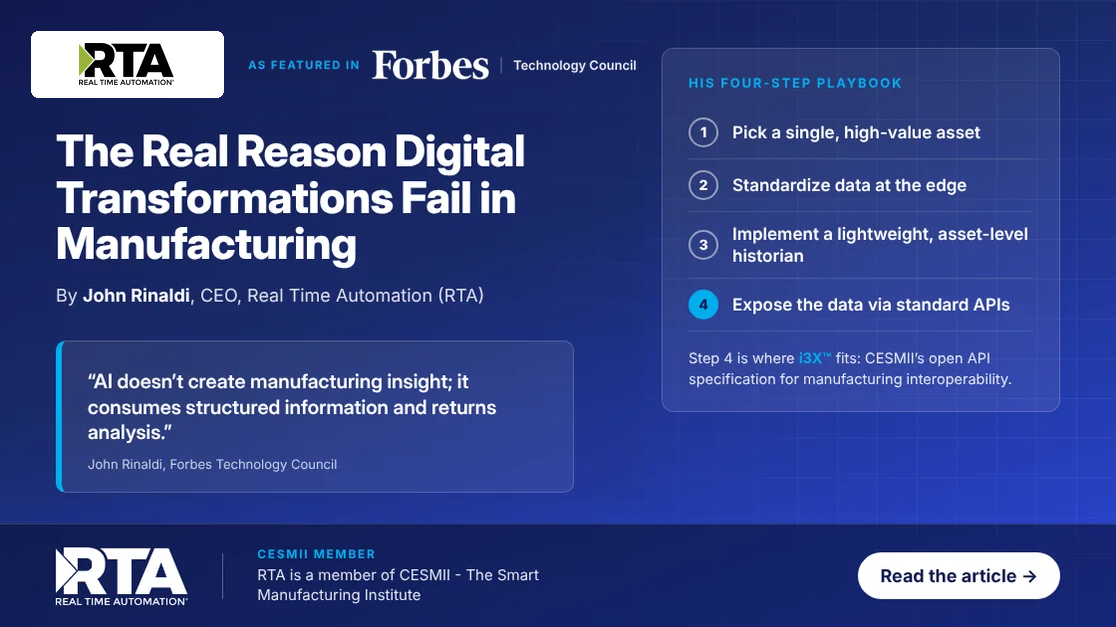
Writing for the Forbes Technology Council, John S. Rinaldi, CEO of Real Time Automation (RTA), argues that most manufacturing digital transformations stall for a simple reason: the data underneath them isn't ready.
Predictive maintenance, quality analytics and digital twins all depend on data that is accessible, consistent and well governed. In practice, analytics teams spend much of their time cleaning and mapping raw plant data before any analysis can begin.
Rinaldi points to standardized, open information models as the fix. He cites CESMII's Smart Manufacturing Profiles, built on OPC UA foundations, as a way to give data context that carries across systems and vendors. He also notes that open standards from CESMII and the OPC Foundation are breaking vendor lock-in, which lowers the barrier for small and mid-sized manufacturers.
His advice is to start small: pick one high-value asset, standardize its data at the edge, and expand from there.
"The foundation of Smart Manufacturing in 2026 isn't the AI model; it's the standardized data model."
John S. Rinaldi, CEO, Real Time Automation